Ceramic coating is a liquid that bonds to a car's paint and hardens into a clear layer that repels water and dirt. Makers say it also adds gloss and resists UV and light scratches. It is not bulletproof, and a coated car still needs regular washing. Products differ in chemistry, stated durability and who is allowed to apply them.
What is ceramic coating?
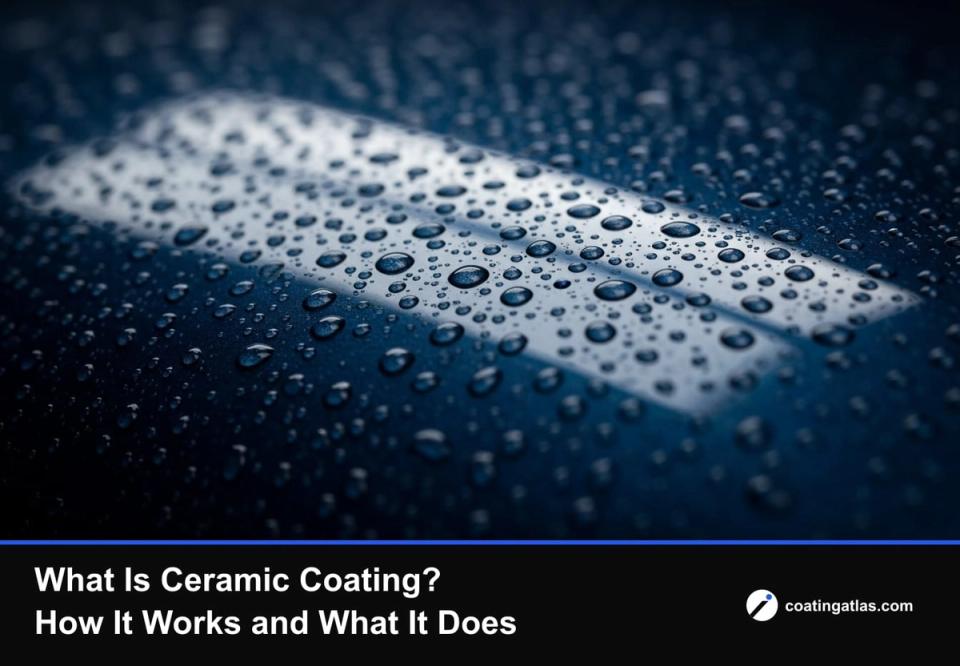
Ceramic coating is a liquid that an installer applies to a car's paint and that hardens into a water-repelling layer. XPEL says its coating is primarily made from a liquid polymer containing silicon dioxide (SiO2) and that it chemically bonds to the paint. The finished layer is hydrophobic, which means it repels water.
The coating is clear. FEYNLAB calls it transparent, so you see your own paint, not a new color. XPEL says its coating bonds to XPEL paint protection film as well. The chemistry varies by brand, and so does what goes into a coating.
How does ceramic coating work?
Ceramic coating works by bonding to the paint's surface and leaving a smooth layer that water and dirt don't cling to. Ceramic Pro says its coating bonds with the existing clear coat. The clear coat is the transparent top layer of a car's paint.
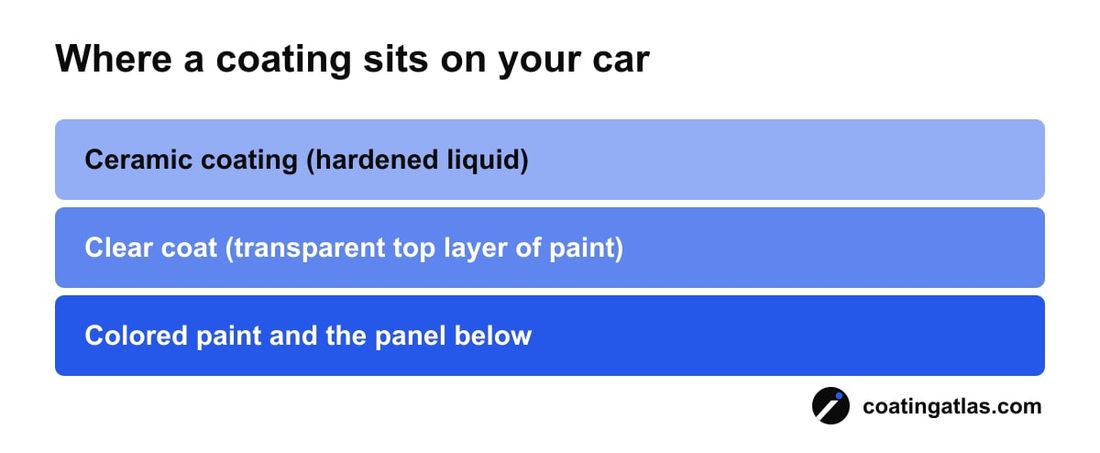
Ceramic Pro describes its coatings as nanotechnology-infused. It says they help protect the factory clear coat and that most debris will not bond to the coated surface within a few days of exposure. Sticky contaminants left in sun and heat still can.
The layer also needs time to harden. Ceramic Pro says its coatings take 2 to 3 weeks to cure, and how long a coating takes to cure differs by maker.
What does ceramic coating do for a car?
A ceramic coating's main job is to make paint easier to keep clean, and to add some resistance to sun and light marks. These are claims from the companies that sell the products, and Coating Atlas hasn't tested any of them.
- Repels water, dirt and contaminants. XPEL and Ceramic Pro both state this.
- Resists UV damage. XPEL says its coating shields paint from UV damage. Ceramic Pro says its coating shields the clear coat from UV rays, oxidation, chemical stains and everyday grime. IGL says its coatings protect against UV rays and environmental contaminants. How a coating handles UV has the detail.
- Resists light marks. XPEL says its coating makes paint more resilient to minor scratches and swirl marks. Ceramic Pro says coatings resist minor damage but aren't built for rock chips or deeper scratches.
- Droppings and sap still need quick cleaning. CARPRO's US distributor tells owners to remove bird droppings from a coating right away. Droppings and sap are worth removing fast.
- Road salt. FEYNLAB lists protection against road salt in winter as a benefit of ceramic coating. If you drive on salted roads, ask your installer what the product's maker says.
Does ceramic coating make a car shinier?
Makers say a coating adds gloss. On glossy paint, XPEL says its coating creates a smooth, high-shine surface that amplifies depth and clarity. Ceramic Pro says its coating adds gloss and depth, and GYEON says Mohs EVO gives gloss and a noticeable darkening effect.
Ceramic Pro ties its shine claim to paint that has had proper paint correction first. Paint correction means polishing out defects before the coating goes on. IGL says its coating gives more gloss than traditional wax, and ceramic coating vs wax covers that comparison.
Ask a shop to show you a car it has coated before you pay.
What does ceramic coating not do?
Ceramic coating does not make paint indestructible. Ceramic Pro says plainly that its coating is not bulletproof and requires routine aftercare. FEYNLAB says a coated car is not "dirt resistant" and still needs washing.
- Deeper scratches. FEYNLAB says coatings are certainly not scratch-proof and cannot conceal deep scratches or other flaws. IGL says small scratches may be minimized, but deeper ones may need professional reapplication. Read more on whether a coating can prevent scratches.
- Stone chips. Ceramic Pro says coatings aren't built to handle rock chips. That is where film and coating differ most.
- Water spots. CARPRO's US distributor warns that water spotting can cause permanent damage and says to keep the car free of spots for 48 hours after installation.
- Careless washing. IGL says harsh chemicals, abrasive tools, automatic brush washes and clay bars can damage a coating.
- Neglect. FEYNLAB says a coating is not a "set it and forget it" solution.
What does it feel like to own a coated car?
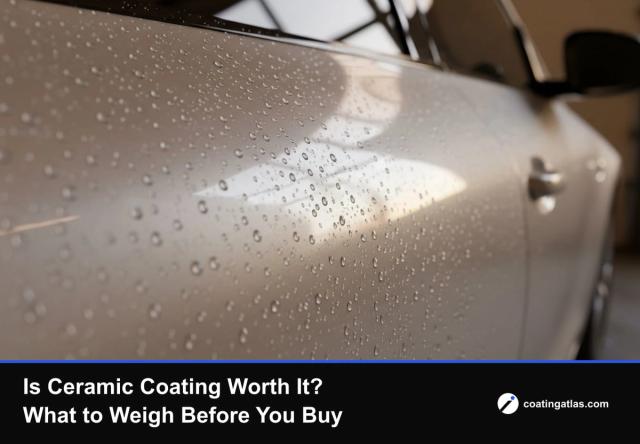
You'll notice water beading and rolling off the paint, and dirt that wipes off more easily. Ceramic Pro says your car will still get dirty, just at a slower rate. So plan on washing, not on skipping it.
A few common worries:
- If you're worried it will hide scratches. It won't. FEYNLAB says the coating is transparent and cannot conceal deep scratches or other flaws. Ceramic Pro says any pre-existing damage gets sealed beneath the coating unless it's addressed first.
- If you're worried you can't undo it. XPEL says you'll need to polish or use an abrasive method to remove it, and that professional detailing services can safely remove it without damaging the paint. Ceramic Pro says it can't be rubbed, wiped or washed off. Removal is a job for a skilled person.
- If your car is brand new. FEYNLAB says even new vehicles come with invisible contaminants, and that prep work is essential. Read coating a new car before you assume it needs nothing.
- If your paint is matte or satin. XPEL says it makes ceramic coatings for satin and matte finishes. Not every coating is for every finish, so see coating matte paint.
Say you drive a dark sedan 40 miles each way on the interstate and park outside at work. You want less time scrubbing off bugs and dust. A coating fits that wish, as long as you accept that you'll still wash the car and you'll still park under a tree at your own risk. IGL says not to park under trees, because of droppings and sap.
Say you're picking up a used car with swirl marks in the paint. A coating won't hide them. Ask the shop whether polishing is in the quote.
Are all ceramic coatings the same?
No. Makers describe different chemistry, sell different tiers and state different durations. This table doesn't rank them. It shows what each maker says on its own pages.
| Maker and product | What the maker says | Stated durability |
|---|---|---|
| XPEL FUSION PLUS | XPEL says ceramic coating is a liquid polymer containing SiO2; FUSION PLUS comes in PREMIUM, SATIN and LITE tiers | Transferable warranties of 8, 4 and 1 years; PREMIUM needs an annual inspection |
| GYEON Mohs EVO | A fluoro-modified polysilazane base | One layer up to 3 years, two layers about 48 months |
| IGL Ecocoat Kenzo | Described as its signature graphene-reinforced coating | IGL says its products, such as Ecocoat Kenzo, protect for up to 5 years; it also says high-quality coatings last 2 to 5 years with proper care |
| FEYNLAB | Sold as The Original Ceramic, Ceramic V3, Ceramic Ultra V3, Ceramic Plus and Self Heal Plus | Warranties of 1, 3, 5, 5 and 7 years |
| Ceramic Pro | Nanotechnology-infused; Ceramic Pro 9H is named for its 9H pencil-hardness rating once cured and is applied only by certified Elite Dealers | Not stated; 2 to 3 weeks to cure |
A warranty term is a contract, not a promise of how long the paint will look good, and each one has conditions. Read how long ceramic coating lasts before you compare years. Graphene-based coatings have their own page: graphene versus ceramic coating.
The next table shows which coating brands shops name on their pages. It shows what shops name, not which product is better.
| Brand | Shops naming it |
|---|---|
| Ceramic Pro | 659 |
| System X | 607 |
| Gtechniq | 498 |
| Gyeon | 220 |
| IGL Coatings | 167 |
| CarPro | 159 |
| Feynlab | 137 |
| Opti-Coat | 114 |
How is ceramic coating applied?
Ceramic coating goes on in steps, and the prep matters as much as the product. GYEON says preparation is always the most important part of any coating. Ceramic Pro says a flawless surface is essential before application: washing, claying and buffing. A professional, XPEL says, will treat and remove any contaminants first.
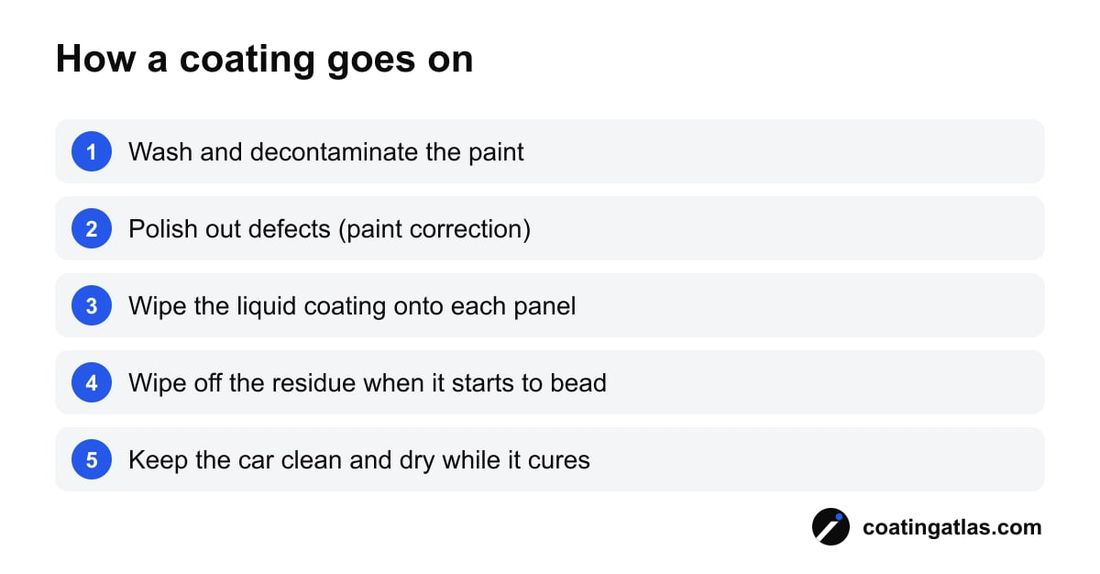
With Mohs EVO, GYEON says the product is wiped off once it starts to sweat or bead, usually within 30 seconds. After that, care windows differ by maker:
- GYEON: keep the car dry for 12 hours and avoid washing for 14 days.
- IGL: avoid contact with water, abrasives and high or low pH soaps for the first 24 hours.
- CARPRO's US distributor: no soap wash for 5 days unless you're removing bugs.
- Ceramic Pro: do not wash for at least two weeks after delivery, and expect 2 to 3 weeks of curing.
XPEL says expert installation ensures even coverage and that improper application risks uneven results. Ask any shop what prep it includes and get the product name in writing. You can also apply a coating yourself, and aftercare matters either way.
What does professional ceramic coating cost, and how do you find a shop?
Professional ceramic coating prices depend on the car, the paint's condition and the product. XPEL says the main downside of a coating is the upfront cost, which can be higher than traditional waxing. It adds that a coating can save time and money in the long run by reducing the need for regular waxing. These are prices shops publish, not quotes.
| Package | Typical price | Shops |
|---|---|---|
| 1-year coating | $350–$650 | 390 |
| 3-year coating | $650–$1,000 | 604 |
| 5-year+ coating | $900–$1,400 | 1,053 |
| Wheels & glass | $150–$300 | 519 |
For more detail see ceramic coating cost, or find a ceramic coating installer near you and ask for the exact product and its warranty terms. How we rank explains how shops are ordered on the site.
Questions
Is ceramic coating the same as wax?
No, though makers compare them. Ceramic Pro says wax is unnecessary on its coatings because wax won't bond to them. IGL says its coating gives more protection and gloss than traditional wax. Both are makers' claims about their own products.
Do you still have to wash a coated car?
Yes. Ceramic Pro says its coating is not bulletproof and needs routine aftercare, and says your car will still get dirty, just at a slower rate. FEYNLAB says a coated car is not dirt resistant and still needs washing.
Can you apply ceramic coating yourself?
Some makers sell products for it, but XPEL says expert installation ensures even coverage and that improper application risks uneven results and limits the benefits. FEYNLAB calls the job complicated and time-consuming. GYEON describes some of its coatings as for enthusiasts new to the process, and says preparation is the most important part of any coating.
Is a ceramic coating permanent?
Ceramic Pro describes a semi-permanent bond and says the coating can only be removed by abrasion. Makers still state lifespans in months or years, so it wears out over time. See how long ceramic coating lasts for each maker's figures.
Sources
- XPEL FAQs (automotive ceramic coating)
- XPEL: Choosing the right ceramic coating (FUSION PLUS)
- Ceramic Pro: Is ceramic coating good for your car's paint?
- Ceramic Pro coating aftercare
- Ceramic Pro home page
- GYEON USA: Mohs EVO
- IGL Coatings: ceramic coating aftercare guide
- CARPRO's US distributor: how to maintain your CQUARTZ coating
- FEYNLAB warranty registration
- FEYNLAB: Myths vs facts about ceramic coatings
Checked 5 Nov 2026. Manufacturers change their terms, so confirm with the current document.
A US directory of PPF and ceramic coating installers. Our guides draw on manufacturers' published information and the prices shops publish on their own websites. Brands and shops don't pay for coverage. Read our editorial policy.