A useful PPF quote is a written document that names the exact film, lists every panel covered, says what prep and paint correction are included, and spells out the warranty and what it needs from you. Package names like full front differ between shops, so two quotes with the same name can cover different panels. Without those lines, two totals can't be compared.
What should a PPF quote include?
A PPF quote should include the exact film, each panel covered, the prep, the warranty terms and any extras, all in writing. The total at the bottom is the least useful line, because it only means something once the lines above it match another quote.
This page is a checklist for the document itself. For the questions to ask out loud, see questions to ask a PPF installer. For judging the shop, see how to choose a PPF installer.
| Line on the quote | What to look for |
|---|---|
| Film | Brand and full product name |
| Panels | A list, one line per panel |
| Edges and cutting | How edges are finished, pattern or hand cut |
| Prep | Washing, decontamination, polishing: included or extra |
| Warranty | Film terms, shop terms, registration, inspections |
| Extras | Coatings, matte or satin finish, add-on parts |
| Terms | Timeline, deposit, what happens if scope changes |
The examples below are made up to show how a vague line differs from a clear one.
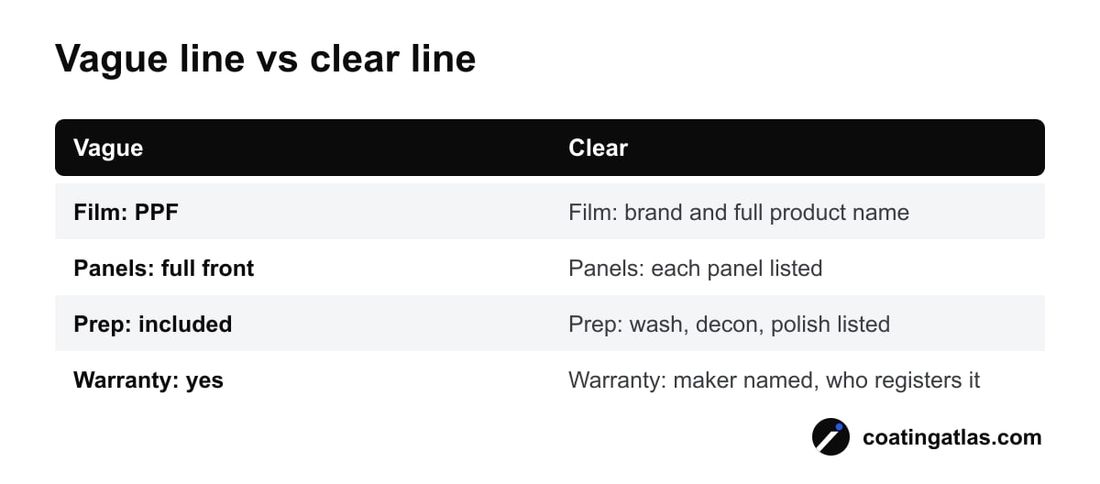
Does the quote name the exact film?
A quote should give the full product name, not just the brand. Each brand sells several films with different terms. XPEL's warranty page lists 10 years for ULTIMATE PLUS, 7 years for EXO ARMOR and 5 years for PROTEX Lite. SunTek says certain restrictions apply to its warranty and tells buyers to see the dealer for warranty details. So "XPEL" or "SunTek" on a quote leaves the important part blank.
Gloss, satin and color films are separate products. XPEL sells ULTIMATE PLUS as gloss and STEALTH as satin, so the quote should say which finish you are buying. Matte and satin PPF explains the options.
Does the quote list every panel?
A quote should list every panel, because package names differ between shops. XPEL's Tesla page lists full body, full front and a Wear & Tear Kit as options and says coverage varies by vehicle model. So ask what a package name means at that shop, panel by panel.
Ask for one line each for the hood, fenders, bumper, mirrors, headlights and any other area you are paying for. Ceramic Pro's article names the front end, fenders, front bumper, hood, grille, side-view mirrors and door edges as high-exposure areas, which gives you a starting list. Then ask two follow-ups:
- Where does the film stop? XPEL says that on a partial front wrap the edge may be slightly noticeable, depending on paint color and finish.
- What stays uncovered? XPEL says even full-body film can leave edges, corners, tight contours and door jambs showing original paint.
Which parts of a car should get PPF goes through full body against full front.
Does it say how the film is cut and the edges finished?
A quote can say whether film is cut from a pattern or from bulk, though it doesn't have to. XPEL sells pre-cut kits made to fit an exact make and model. STEK says its course covers plotter pre-cut kits as well as some bulk or hand-cut installs. Neither method alone is a reason to reject a quote. It is a reason to ask how the shop finishes edges and where seams will sit.
Does the quote say what prep and paint correction are included?
A quote should state what prep is in the price and what is extra. Film goes over whatever is on the paint, and warranties can exclude what was already there. XPEL's warranty excludes products installed with known or visible manufacturing defects at the time of installation, a list that includes scratches and chips to the painted surface. On several films it also excludes areas not re-wrapped after a paint or body repair. LLumar says its film is designed for original painted surfaces and that issues with aftermarket and repaired paint are not covered.
Look for lines on washing, decontamination and any polishing, and for a note on how existing chips or scratches will be handled. Ceramic Pro's article says a new vehicle requires less paint correction or prep work. If paint correction is a separate line, the quote should show it separately instead of folding it in.
What warranty details belong on a PPF quote?
The quote should say what warranty comes with the film and what you must do to keep it. A warranty term is a contract, not a promise of how long the film will look good.
- Paperwork. XPEL's terms ask for a warranty card and an original receipt that identifies the coverage areas, plus proof of installation from an authorized installer.
- Registration. STEK's global warranty page says its warranty must be registered through STEK ONE within 30 days of installation. Ask who does it.
- Inspections. XPEL says its ULTIMATE FUSION warranty requires a yearly inspection by a certified Fusion installer, and the owner pays the fees.
- Labor. STEK says its remedy covers the affected area and that labor and removal are not covered. Ask whether the shop covers labor itself and get it in writing.
- Coatings. XPEL's and STEK's warranties each exclude non-brand ceramic coatings, so name any coating on the quote.
- Transfer. XPEL says ULTIMATE PLUS, STEALTH and FUSION warranties transfer with proof of the original install date. COLOR PPF doesn't transfer.
Two warranties can apply: the film maker's and the shop's own. The quote should say which is which. PPF warranties and your car's warranty covers the second question.
What extras and aftercare belong on the quote?
A quote should list any add-ons separately, so you can see what you chose. That includes a coating over the film, a satin or matte finish, and aftercare products. XPEL says STEALTH should be sealed with XPEL Ceramic Boost at least once every 6 months to maintain the satin finish, which is an ongoing step you may want to ask about.
Ask also for the maker's first-wash and care sheet for your film. Makers differ: XPEL says to wait 48 hours for ULTIMATE PLUS, ULTIMATE FUSION and STEALTH and 72 hours for COLOR PPF. SunTek says to wait 3 days. LLumar says three days (72 hours). How to wash PPF covers the routine after that.
What should you check before you sign?
Get a signed copy of the quote, and check that it says what happens if the work changes. The FTC's general auto repair advice is that an estimate should identify the work, the parts and the labor, that you should get a signed copy, and that the shop should agree to contact you for approval before going over a set amount. That isn't specific to PPF, and the FTC notes your state may require the approval step.
Also look for the timeline, any deposit and its terms, and what happens if you cancel. Those lines are buying advice, not maker rules, so ask the shop to state them plainly.
What do owners worry about when reading a quote?
Most worries are about surprises: a total that grows, coverage that turns out smaller than expected, or a warranty that doesn't help.
If you're worried the price will grow, ask the shop to agree in writing to contact you before going over the quote. The FTC gives this as general advice for auto repair.
If you're worried the coverage is smaller than you thought, go back to the panel list. Package names differ by shop, so a list beats a label.
If you're worried the warranty won't help, read what it excludes. XPEL's warranty excludes rock and road debris impact, and STEK's excludes damage from the impact of rocks and road debris. The warranty covers film defects, not the chips the film is there to take.
Say you drive on gravel roads and want a front package. You'd ask the shop to list each panel, name the film, and show you the warranty page, so you know the film's terms before you pay.
Say two quotes arrive and one has no warranty line. You'd ask that shop which film and which warranty applies, and ask it to add the answer to the quote before you compare totals.
How do you compare two quotes?
Compare two quotes by lining up the table above and finding the first row where they differ. If the film, panels or prep differ, you are comparing two different jobs and the totals mean little. These are prices shops publish on their websites, not quotes, and they work as a sanity check before you ask for one.
| Package | Typical price | Shops |
|---|---|---|
| Partial front | $900–$1,300 | 611 |
| Full front | $1,800–$2,200 | 754 |
| Track pack | $2,400–$3,000 | 322 |
| Full body | $5,000–$6,500 | 631 |
For more on what shops publish, see PPF cost. When you have the lines you need, find a PPF installer and ask each shop for a written quote on the same film and panels. You can also browse by state, such as Texas or Arizona.
Questions
Is there a standard definition of full front?
Package names differ by shop. XPEL's Tesla page lists full body, full front and a Wear & Tear Kit as options and says coverage varies by model. Ask the shop to list the panels on the quote.
Do I need a written estimate?
It is the sensible default. The FTC's general auto repair advice is to get an estimate that identifies the work, parts and labor, to get a signed copy, and to have the shop agree to contact you before going over an agreed amount. That advice isn't specific to film, and state law may add rules.
Is the lowest quote worse?
Not necessarily. Check that it names the same film and the same panels as the others, and that the warranty lines match. A lower total can be a smaller package or a different film.
Should a quote name the warranty?
Yes. Makers state different terms by film and attach conditions. XPEL lists 10 years for ULTIMATE PLUS and 7 years for EXO ARMOR, for example. A quote that only says warranty included leaves the film and the conditions unclear.
Can the price change after I agree?
It can if the work changes. The FTC advises asking that the shop contact you for approval before doing work over an agreed amount, and notes that your state may require this approval step. Ask for that promise in writing.
Sources
- XPEL warranty information
- XPEL FAQs
- XPEL product care
- XPEL Tesla PPF page
- XPEL pre-cut kits
- STEK USA: PPF training
- STEK global PPF warranty
- SunTek PPF FAQ
- LLumar PPF FAQ
- Ceramic Pro: pros and cons of PPF on new cars
- FTC: Auto Repair Basics
Checked 5 Nov 2026. Manufacturers change their terms, so confirm with the current document.
A US directory of PPF and ceramic coating installers. Our guides draw on manufacturers' published information and the prices shops publish on their own websites. Brands and shops don't pay for coverage. Read our editorial policy.