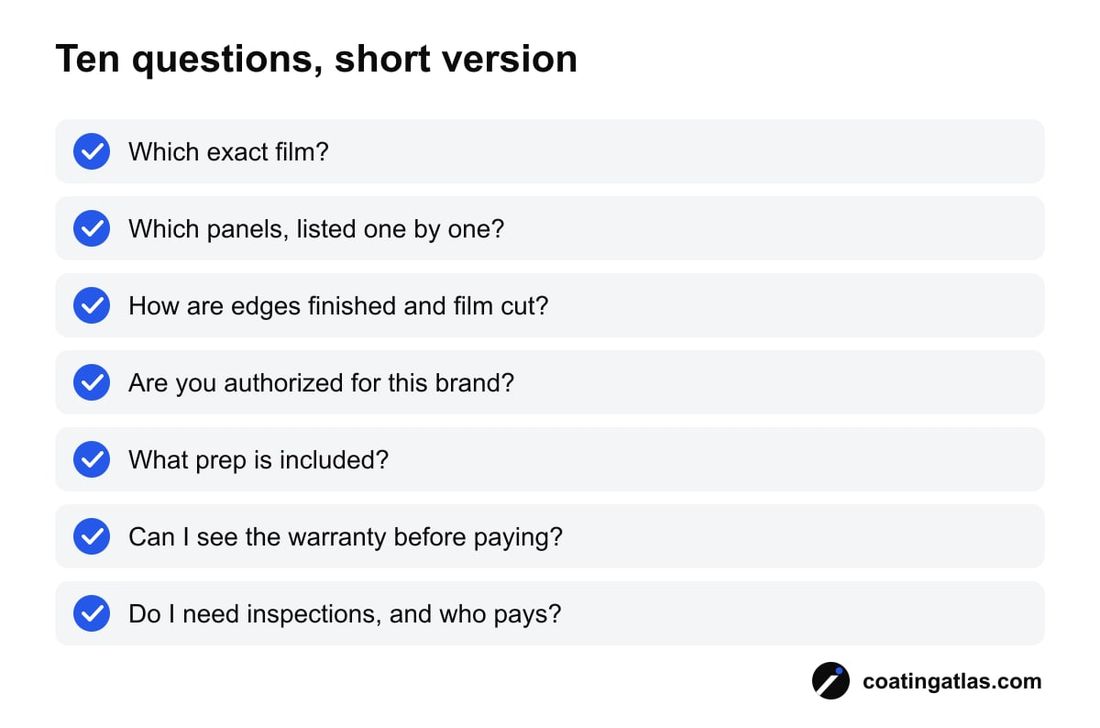
Ask a PPF installer which exact film you are getting, which panels it covers, how the edges are finished and what prep is included. Then ask what the warranty requires and who pays if something fails. The answers tell you more than the price does, and a good shop will answer without hurry.
What should you ask a PPF installer?
Ask a PPF installer ten things, in four groups: the film, the shop, the warranty and aftercare. You don't need to ask them all at once. Send the film and panel questions by message to get a written quote, then ask the rest when you visit.
If you are still choosing a shop, how to choose a PPF installer covers how to judge one. This page is the script.
Questions about the film
1. Which exact film are you fitting?
Get the full product name, not just the brand. Makers sell several films with different terms. XPEL's warranty page lists 10 years for ULTIMATE PLUS and STEALTH, 7 years for EXO ARMOR and 5 years for PROTEX Lite. ULTIMATE FUSION adds a separate 4-year term for oxidation, loss of gloss, UV damage and fading.
A good answer names the film and tells you where its warranty terms are published. If the shop says only "XPEL" or "SunTek," ask which line. What PPF is made of explains why the lines differ.
2. Which panels does this price cover?
Ask for a list of panels, in writing. XPEL's Tesla page lists full body, full front and a Wear & Tear Kit as options and says coverage varies by vehicle model. So a package name alone can mean different things at different shops.
A good answer lists each panel, plus whether headlights, mirrors and door edges are in. Which parts of a car should get PPF helps you decide what to ask for.
3. How will the edges be finished, and how is the film cut?
Ask how the shop finishes edges, and whether it cuts film from a pattern, by hand from bulk film, or both. XPEL sells pre-cut kits made to fit an exact make and model. STEK says its course covers plotter pre-cut kits as well as some bulk or hand-cut installs. Either way, ask why the shop works that way on your car.
XPEL says that on a partial front wrap the edge may be slightly noticeable, depending on color and finish, and that full-body film can leave edges, corners, tight contours and door jambs showing original paint. Ask to see a finished edge on a car like yours.
Questions about the shop
4. Are you an authorized installer for this brand?
Ask which brand, and then check it yourself on the maker's own installer finder. STEK's locator, for instance, separates Authorized installers from Black Label installers. A good answer is specific and easy to verify. Our brand pages link to each maker's finder where one exists.
The FTC adds a general point about repair shops: certification alone is no guarantee of good or honest work. So also ask whether the shop has worked on your make or model before.
5. What prep is included, and what happens to existing paint damage?
Ask what washing, decontamination and polishing are in the price, and what the shop does about chips or scratches already on the paint. Film goes over whatever is there.
Warranties can exclude what was already there. XPEL's warranty excludes products installed with known or visible manufacturing defects at the time of installation, a list that includes scratches and chips to the painted surface. On several films it also excludes areas not re-wrapped after a paint or body repair. LLumar says issues with aftermarket and repaired paint are not covered, and that its film is designed for original painted surfaces. LLumar also advises against waxing or coating the car before its film goes on.
Questions about the warranty
6. Can I see the warranty terms and my paperwork before I pay?
XPEL's terms refer to a warranty card and an original receipt that identifies the coverage areas. The FTC says there is no standard repair warranty and advises getting the terms in writing. Ask who registers the warranty. STEK's global warranty page says its warranty must be registered through STEK ONE within 30 days of installation.
7. Does the warranty need inspections, and who pays?
Some do. XPEL says its ULTIMATE FUSION warranty requires an annual inspection by a certified Fusion installer, and that skipping it voids the warranty. The owner pays the inspection fees. Find out before you buy, not after.
8. Will a ceramic coating on top affect the film warranty?
If you plan to add a coating, ask which one. XPEL says you can coat PPF with ceramic coating and that its FUSION PLUS coating will not void its PPF warranty. Its warranty also lists use of non-XPEL branded ceramic coatings as an exclusion. STEK's warranty similarly excludes non-STEK branded ceramic coatings or other third-party coatings applied after installation.
A good answer names the coating and the maker whose terms apply. See can you ceramic coat over PPF for more.
9. If the film fails, who fixes it and who pays for labor?
STEK says its warranty remedy covers only the affected area, and that labor, removal and reinstallation are not covered. XPEL's warranty terms say it will remove or replace defective film at its option, cover parts and labor, and that replacement is the exclusive remedy. Its claims FAQ says labor may be covered depending on the product and situation. XPEL also says all repairs must be approved first.
Claims usually start with the shop. XPEL says you notify the authorized installer who did the work, in writing, and that it allows 2 to 3 business days to review a claim. Ask the shop what its own promise on labor is, and get it in writing.
Questions about afterwards
10. When can I wash it, and how?
Makers differ, so ask the shop to write down the sheet for your exact film.
| Maker | First wash | Wash rules it states |
|---|---|---|
| XPEL | 48 hours for ULTIMATE PLUS, ULTIMATE FUSION and STEALTH; 72 hours for COLOR PPF | Hand wash recommended for COLOR PPF; no automatic tunnel washes on COLOR PPF; keep a pressure washer 3 feet away on COLOR PPF |
| SunTek | 3 days | Best practice is to avoid automatic washers and power washes, which could cause film lifting |
| LLumar | Three days (72 hours) | Pressure washing and automatic washers are discouraged; lifting from them isn't covered |
| STEK (global warranty page) | 48 hours | Recommends hand washing; says automated car washes increase the likelihood of surface scratches penetrating the top coat |
XPEL's warranty also excludes damage from improper washing and automatic car washes. How to wash PPF covers the routine.
What answers should make you pause?
These answers are signs to ask more, not proof of a bad shop.
- The shop won't name the exact film. Without it, you can't read the warranty.
- The shop won't put the panel list or warranty in writing. The FTC's advice is to get terms in writing.
- The shop claims a warranty the maker's page doesn't show. Check the maker's own page.
- The shop says every film is the same. Ceramic Pro's article says not all paint protection films are equal.
What do owners worry about before booking?
Three worries come up most: paying for the wrong thing, a problem after the car is gone, and sounding like you don't know enough to ask.
If you're worried you'll sound uninformed, read from a list. A shop that is good at its work should be glad to answer. Bring the short checklist above and write the answers down.
If you're worried about a surprise on the bill, the FTC says to ask for an estimate that identifies the work, the parts and the labor, and to get a signed copy. It also says to have the shop agree to contact you before going over an agreed amount. That is general auto repair advice, and your state may add rules.
If you're worried about what happens after, ask questions 6 to 9 again, slowly. Those cover registration, inspections, labor and who handles claims.
Say you're in Florida and a shop quotes a full front. You'd ask which film, then which panels, then whether you can see the warranty before paying. Start with PPF installers in Florida.
Say you already own a ceramic coating and want film on the hood. You'd ask question 8 first, because a coating can touch the film warranty.
What should you bring when you ask for a quote?
Bring your questions and ask for a written estimate. See what a PPF quote should include for the line items. Then find a PPF installer and ask the same ten questions at each shop. For prices shops publish, see PPF cost.
Questions
What is the most important question to ask a PPF installer?
Which exact film and product line you are being quoted. Makers sell several films with different terms. XPEL's warranty page, for example, lists different terms for different films, so a brand name alone doesn't settle what you get.
Should I ask to see the warranty before paying?
Yes. The FTC says there is no standard repair warranty and advises getting the terms in writing. XPEL's terms refer to a warranty card and an original receipt that identifies the coverage areas.
Is a hand-cut install worse than a pre-cut kit?
Not automatically. XPEL sells pre-cut kits made to fit an exact make and model, and STEK trains installers on both plotter pre-cut kits and some bulk or hand-cut installs. Ask the shop why it cuts the way it does on your car.
What should I do if I don't understand an answer?
Ask the shop to write it down. A written answer can be checked against the maker's warranty page, and a shop that is sure of its answer should not mind putting it in writing.
Do I need to ask all ten questions in person?
No. Ask the film and panel questions by message so you get a written quote. Save the questions about edges, prep and aftercare for a visit, where you can see the shop and its finished work.
Sources
- XPEL warranty information
- XPEL FAQs
- XPEL product care
- XPEL Tesla PPF page
- XPEL pre-cut kits
- STEK USA: find an installer
- STEK USA: PPF training
- STEK global PPF warranty
- STEK USA FAQ
- SunTek PPF FAQ
- LLumar PPF FAQ
- FTC: Auto Repair Basics
Checked 5 Nov 2026. Manufacturers change their terms, so confirm with the current document.
A US directory of PPF and ceramic coating installers. Our guides draw on manufacturers' published information and the prices shops publish on their own websites. Brands and shops don't pay for coverage. Read our editorial policy.