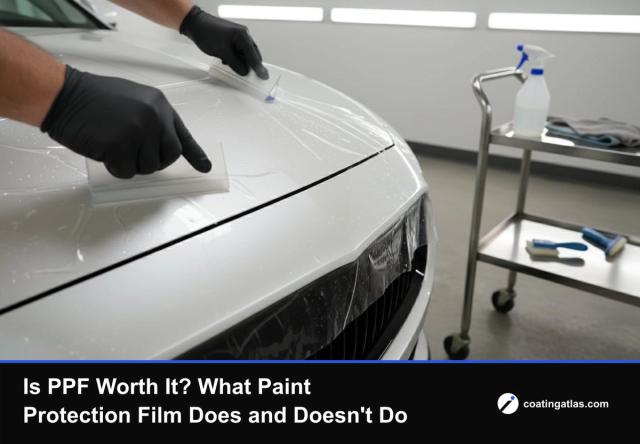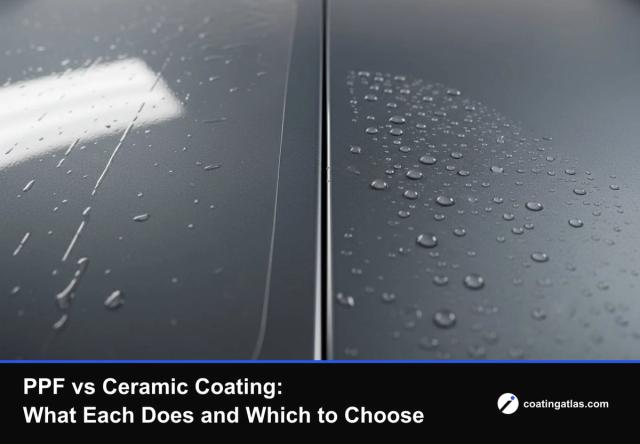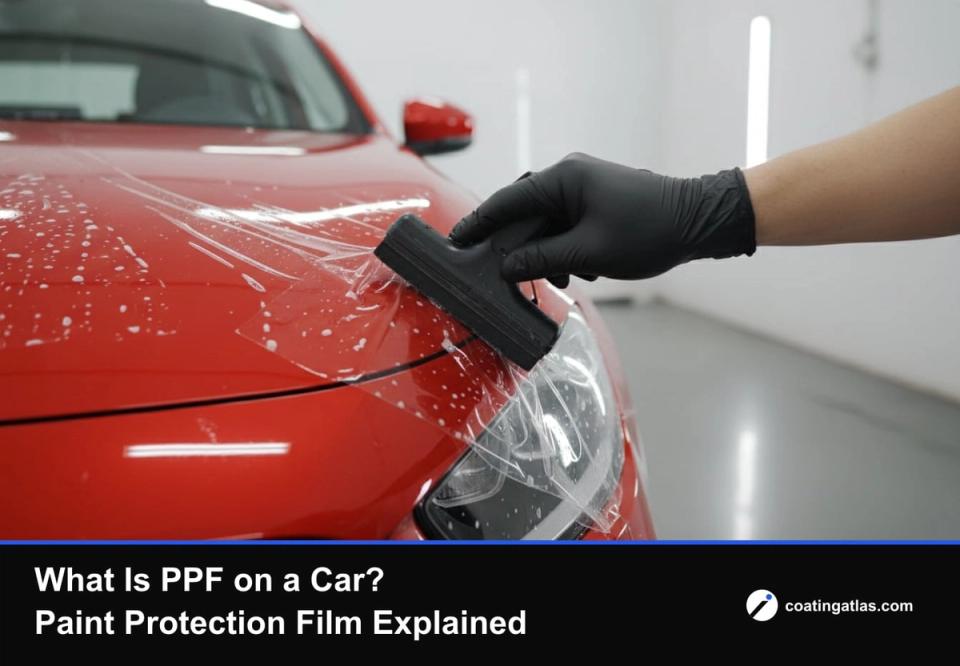
PPF on a car is paint protection film, a clear polyurethane film that an installer fits over the paint. Makers say it is meant to take rock chips and scratches instead of the paint, and some films self-heal light marks with heat. Makers state film warranties of 10 years or more on some films, but a warranty covers defects in the film and is not a promise of how your paint will look.
What is PPF on a car?
PPF on a car is paint protection film: a clear polyurethane film that an installer applies over the paint. XPEL describes it as a "transparent, durable polyurethane film" meant to protect paint from scratches, chips, stains and environmental damage.
PPF installers cut the film to fit each panel, then bond it to the paint with adhesive. Makers say the film is there to take a stone or a scrape instead of the paint.
Is PPF a wrap, a coating or something else?
PPF is a film, so it is not a liquid coating, and it is not the same product as a colored vinyl wrap. Shops sometimes say "PPF wrap" because the film is wrapped around panels, but the product is still the film. People also search "PPF coating", which usually means ceramic coating, a liquid that hardens into a thin layer.
The makers describe the film this way:
- XPEL calls it a transparent, durable polyurethane film.
- STEK says its film is made from thermoplastic polyurethane (TPU), a clear plastic.
- Ceramic Pro calls PPF a polyurethane-based substance.
If you are weighing film against a coating, read PPF vs ceramic coating. If you are weighing it against a color change, PPF vs vinyl wrap covers that.
What is PPF made of, and how does it work?
PPF is a stack of thin layers, and the layers explain most of what makers claim. The film sits on the paint, held by adhesive, with a clear top coat on the outside.
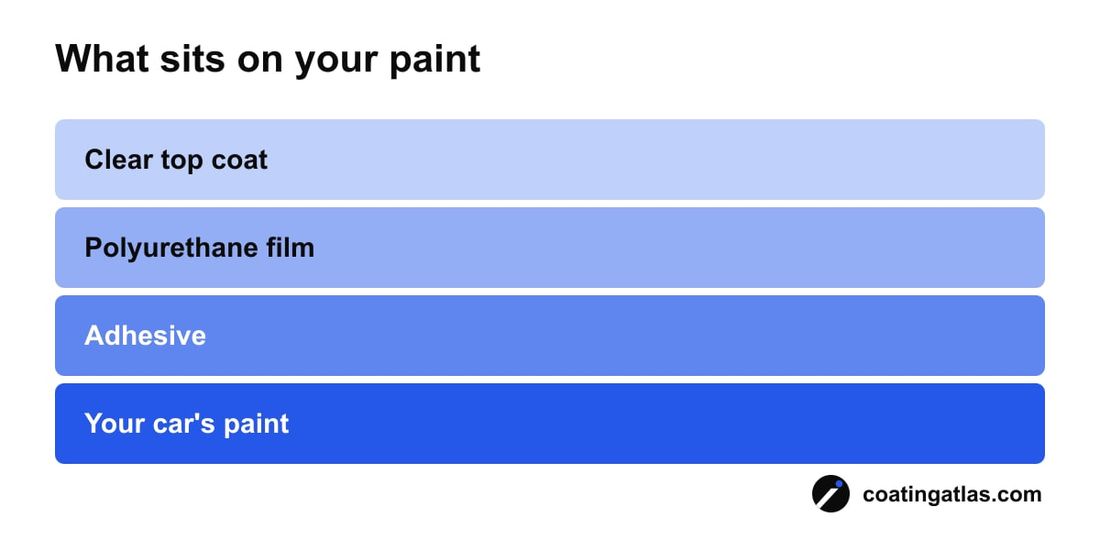
Here is how each maker describes its own film:
- STEK says DYNOshield is TPU plastic with a nano-ceramic-infused top coat bonded to the film as a liquid. It lists the film as 8 mils thick. A mil is one thousandth of an inch.
- SunTek says each of its PPF products has a scientifically formulated top coat. The top coat protects the urethane against surface damage.
- LLumar says its film has a proprietary top coat that protects the urethane against surface scratches.
- Avery Dennison (its Asia Pacific site) says PPF is cut to fit the vehicle and adhered with adhesive and heat.
Why do makers say PPF heals itself?
Makers say a heat-activated top coat lets light scratches fade. Avery Dennison's Asia Pacific site says a high-performing PPF's molecular structure can reform itself with ambient heat. SunTek names the heat sources: the sun, a warm body panel, engine heat or warm water. STEK says light scratches can be removed with hot water.
There is a limit, and two makers state it. XPEL says deeper scratches that penetrate the film may not fully heal. STEK says a scratch that goes through the top coat will not self-heal. Whether all PPF is self-healing depends on the film you are quoted.
What does PPF protect a car from?
PPF is sold to protect paint from physical damage and from some stains. These are the makers' claims, and we haven't tested any of them.
| What | What the maker says |
|---|---|
| Rock chips and scratches | STEK says DYNOshield is designed to stop rock chips and scratches. Avery Dennison's Asia Pacific site says PPF is engineered to resist impacts from rocks, debris and other objects. |
| Bug acids and bird droppings | XPEL says ULTIMATE PLUS protects against gravel, bug acids and bird droppings. |
| UV and chemicals | Avery Dennison's Asia Pacific site says PPF is resistant to UV radiation and chemicals. STEK lists UV-resistant, anti-yellowing adhesives. |
| Water and staining | XPEL says the ULTIMATE FUSION topcoat is hydrophobic, meaning it repels water, so the surface is easier to wash and keep clean. |
| Yellowing | Warranties name it, with limits. STEK's product page says DYNOshield is warrantied for 10 years against delamination, yellowing, bubbling and cracking. STEK's global warranty page covers yellowing only when caused solely by a material or manufacturing defect, and excludes yellowing from UV or environmental exposure. |
If chips worry you most, how PPF handles rock chips goes deeper. For UV and fading, see PPF and UV.
What does PPF not do?
PPF does not make paint untouchable, and the makers' own pages show some limits.
- It can leave some paint exposed. XPEL says even full-body film can leave edges, corners, tight contours and door jambs showing original paint.
- The edge can show. XPEL says that with a partial front wrap the edge may be slightly noticeable, depending on paint color and finish.
- Its warranty covers the film, not the paint. XPEL says its warranty applies to the film only.
- Its warranty doesn't pay for the damage the film is for. XPEL's warranty excludes rock and road debris impact. STEK's excludes damage from external forces, including the impact of rocks and road debris.
- It goes on original paint. LLumar says its film is designed for original painted surfaces, and that issues with aftermarket and repaired paint are not covered by its warranty.
- Not all films are equal. Ceramic Pro's article says so, which is why the brand and exact film name matter.
What do owners worry about with PPF, and what goes wrong?
Most worries come down to six things: bubbles, visible edges, yellowing, lifting, shine and removal.
You'll notice small bubbles after install. XPEL says most bubbles formed during application typically go away within a few days to a few weeks. If they don't, tell the shop. A good shop will look at it with you.
You'll see an edge line. XPEL says a partial front wrap may show a slightly noticeable edge, and that installers aim to blend it. Ask the shop where the edges will fall on your car.
If you're worried about yellowing, read the warranty wording, because the table above shows how the terms differ. XPEL's ULTIMATE FUSION adds a separate 4-year term for oxidation, loss of gloss, UV damage and fading. A warranty term isn't a promise of how the film will look in year ten.
If you're worried about lifting, watch how you wash. XPEL says to avoid a pressure washer near film edges. SunTek says automatic car washes and power washes could cause film lifting. LLumar says lifting from pressure washing and automatic washes isn't covered by its warranty. XPEL says COLOR PPF should not go through automatic tunnel car washes. How to wash PPF has the routine.
If you're worried about shine, you have choices. SunTek says its gloss film has outstanding optical clarity. XPEL says STEALTH is a satin film that transforms glossy paint into a matte look, so the satin finish is a choice you make on purpose. See matte and satin PPF.
If you're worried about removal, the makers differ on tone. XPEL says removal won't harm the paint when done correctly. SunTek says only a dealer should remove its film and not to fold it over and rip it off. LLumar says film should not be removed in extreme cold. How to remove PPF covers the steps.
Examples of how to apply this
Say you drive 60 miles of highway each way to work. The front of the car takes the most stones, so you might ask a shop for a quote on the hood, bumper, fenders and mirrors first, then decide on more later.
Say you live in Arizona and park outside. Ask the shop what each film's warranty says about fading and yellowing, and whether it needs a yearly inspection. XPEL's ULTIMATE FUSION warranty does. Start with PPF installers in Arizona.
Say you find a few tiny bubbles two days after pickup. Take photos and call the shop that installed it. XPEL says most go away within a few days to a few weeks, so the shop may ask you to wait a little.
Which parts of a car can get PPF?
PPF can go on one panel, a set of exposed areas or the whole car. SunTek says film can cover select areas or the entire car, and XPEL says you can cover your whole vehicle with its film.
Ceramic Pro's article points to high-exposure areas: the front end, fenders, front bumper, hood, grille, side-view mirrors and door edges. XPEL's Tesla page lists full-body, full-front and a Wear & Tear Kit as options and says coverage varies by vehicle model.
Package names differ from shop to shop, so ask for the panel list in writing. Which parts of a car should get PPF compares full body with full front. What a PPF quote should include shows how to read the list.
How is PPF installed, and when can you wash it?
PPF is installed by cutting film to the car's shape and fitting it panel by panel. SunTek says it is a wet installation, like window film, using a soap and water mixture to align the film. XPEL sells pre-cut kits made to fit an exact make and model.
You can't install and wash the same day. Makers give a wait before the first wash, and they differ:
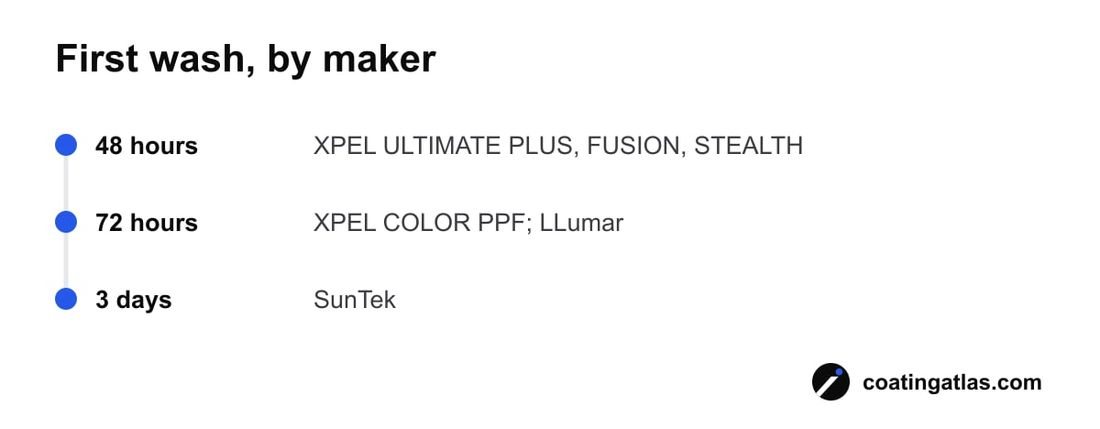
Follow the sheet for your exact film. For more detail, see how PPF is applied and how long PPF takes to cure.
Can you install PPF yourself?
SunTek says it offers no DIY PPF options. XPEL says professional installation is highly recommended for the best results, and that DIY risks bubbles and misalignment. Warranties from XPEL and STEK also ask for an authorized installer, so DIY can cost you coverage.
How do PPF brands and warranties differ?
PPF brands differ in material, finish, warranty length and who may install them. The table shows what each maker states on its own pages. It does not rank them.
| Maker and film | Stated feature | Stated warranty |
|---|---|---|
| XPEL ULTIMATE PLUS | Gloss film, 8 mil thick | 10 years, transferable with proof of install date |
| XPEL STEALTH | Satin finish | 10 years, transferable with proof of install date |
| XPEL ULTIMATE FUSION | Hydrophobic topcoat | 10 years, plus 4 years for oxidation, UV damage and fading |
| STEK DYNOshield | TPU with a nano-ceramic-infused top coat | 10 years on the product page; 12 years on STEK's global warranty page, "may vary by Regions" |
| SunTek Reaction | PPF and ceramic coating features | 12-year limited; restrictions apply |
| LLumar PPF | Proprietary top coat over urethane | Limited warranty |
XPEL says PPF typically lasts between 5 and 10 years, depending on factors such as the quality of the film. That is XPEL's estimate, not a promise. How long PPF lasts explains the difference between a warranty and a lifespan. Whether film affects your car's own warranty is covered in PPF warranties.
The next table shows which film brands shops name on their pages. It shows what shops name, not which film is better.
| Brand | Shops naming it |
|---|---|
| XPEL | 1,287 |
| 3M | 800 |
| STEK | 589 |
| SunTek | 442 |
| LLumar | 438 |
| Avery Dennison | 245 |
| Autobahn | 112 |
| Kavaca | 96 |
For two brands side by side, see XPEL vs SunTek.
What does PPF cost, and how do you find an installer?
PPF prices depend on the film, how much of the car it covers and the shop. These are prices shops publish, not quotes.
| Package | Typical price | Shops |
|---|---|---|
| Partial front | $900–$1,300 | 611 |
| Full front | $1,800–$2,200 | 754 |
| Track pack | $2,400–$3,000 | 322 |
| Full body | $5,000–$6,500 | 631 |
More detail is on the PPF cost page, and many states have their own, such as PPF cost in Texas. When you are ready, find a PPF installer near you, or browse a state like Florida. Then read how to choose a PPF installer and questions to ask a PPF installer. How we rank explains how shops are ordered here.
Questions
Does PPF make a car look shiny?
PPF is meant to be nearly invisible, so it keeps the look of the paint under it. SunTek says its gloss film has optical clarity that helps preserve showroom shine. Finish is also a choice: XPEL sells ULTIMATE PLUS as a gloss film and STEALTH as a satin film that turns glossy paint into a matte look.
Can PPF be removed without damaging the paint?
XPEL says removing its film will not harm the paint when done correctly. SunTek recommends that only a professional SunTek dealer remove its film, and warns that folding the film over and ripping it off can leave adhesive behind.
Is PPF the same as a vinyl wrap?
XPEL, STEK and Ceramic Pro all describe PPF as a polyurethane film. XPEL calls it a transparent, durable polyurethane film, and STEK says its film is made from thermoplastic polyurethane. A vinyl wrap is a separate product.
Can you put ceramic coating over PPF?
XPEL says you can coat PPF with ceramic coating. Warranties may set rules: XPEL's warranty excludes non-XPEL branded ceramic coatings, and STEK's excludes non-STEK branded ceramic coatings. Ask which coating your installer will use before you book.
Does a PPF installer need to be certified?
For some warranties, yes. XPEL says proof of installation from an authorized XPEL installer is required to process a claim, and STEK's warranty applies when an authorized STEK installer fits the film. Check the terms for the film you are quoted.
Sources
- XPEL FAQs
- XPEL PPF overview
- XPEL product care
- XPEL Tesla PPF page
- XPEL warranty information
- XPEL pre-cut kits
- STEK USA: DYNOshield
- STEK global PPF warranty
- STEK USA FAQ
- SunTek PPF FAQ
- LLumar PPF FAQ
- Avery Dennison Asia Pacific site: the science behind paint protection films
- Ceramic Pro: pros and cons of PPF on new cars
Checked 5 Nov 2026. Manufacturers change their terms, so confirm with the current document.
A US directory of PPF and ceramic coating installers. Our guides draw on manufacturers' published information and the prices shops publish on their own websites. Brands and shops don't pay for coverage. Read our editorial policy.