PPF is applied by cleaning the paint, cutting film to fit each panel, and squeegeeing it down wet with a soap solution. You can try it yourself, but makers point you to a professional. XPEL says self-install is possible but recommends a professional, Avery Dennison generally recommends one, and SunTek says it offers no DIY option.
How is PPF applied?
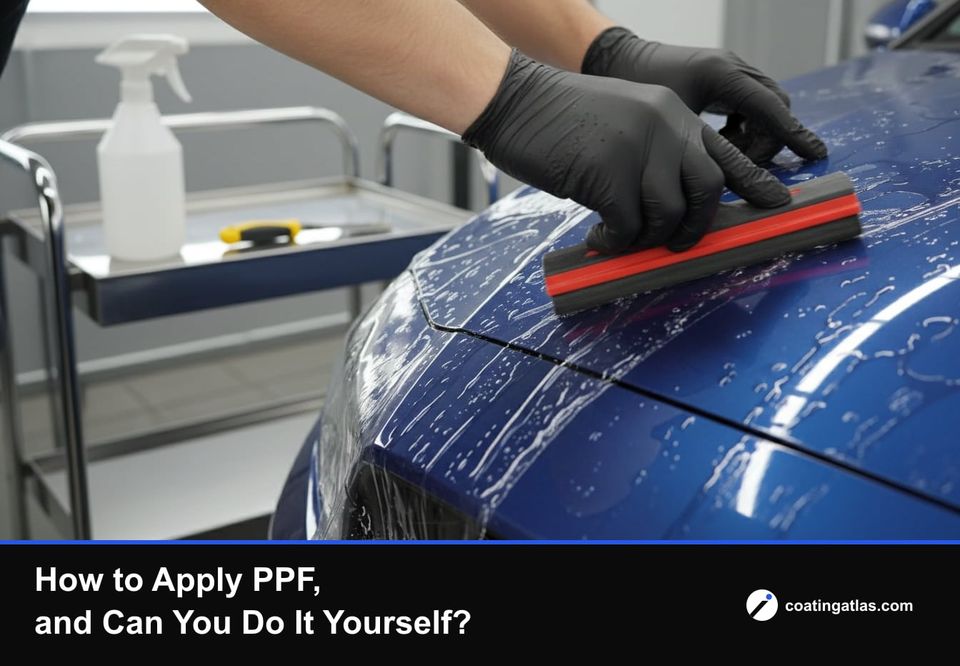
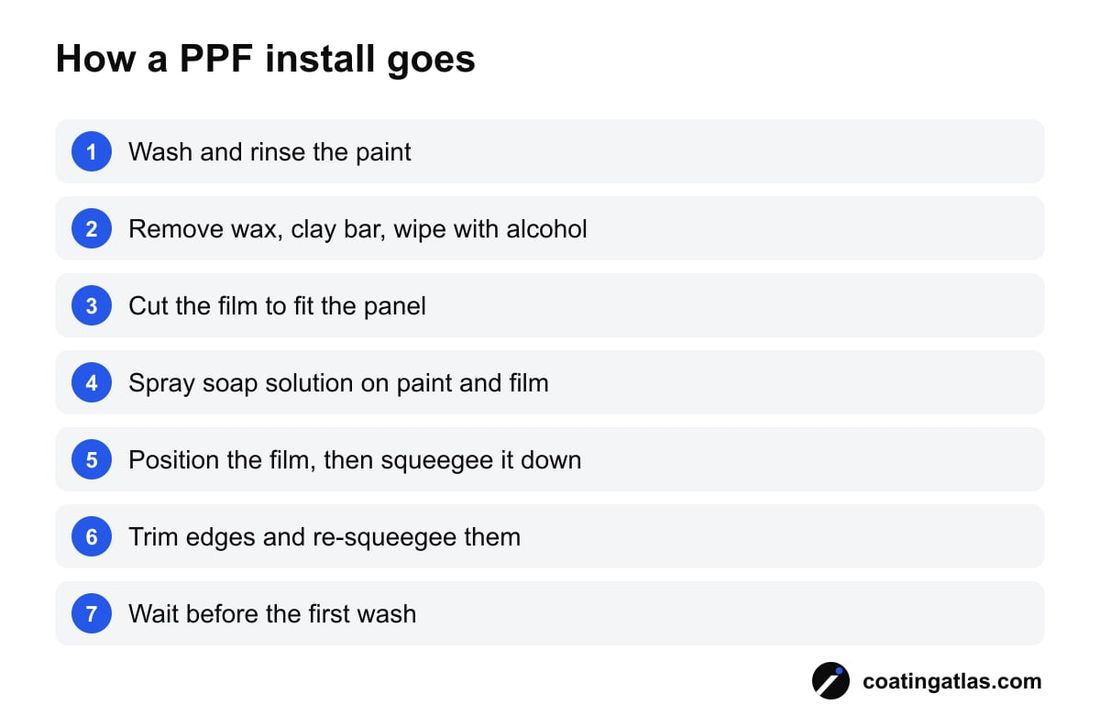
PPF is applied wet. The installer cleans the paint, cuts the film to fit, sprays a soap solution, slides the film into place, and squeegees out the water and air. SunTek calls it a "wet installation" that is similar to window film and uses a soap and water mixture. Avery Dennison says the film is cut to fit the vehicle and then adhered with adhesive and heat.
The process below follows Avery Dennison's own installation bulletin. Other makers may differ in the details.
What prep does the paint need?
Good prep decides how well the film sticks. Avery Dennison's bulletin gives these prep steps:
- Wash the surface with a mild detergent solution, rinse it and dry it with a lint-free cloth.
- Clean and degrease it with isopropyl alcohol. The final clean should always be with isopropyl alcohol.
- Remove all wax and polish residue.
- Clay bar the car (a clay bar is a putty-like bar that lifts bonded grime) so the clear coat is smooth.
- Clean edges, corners and seams extra well.
Avery Dennison also says its film is intended and warranted for fully cured factory (OEM) paint. If a panel has been repainted, tell the shop before you book. For non-factory paint, its bulletin says solvent left in the paint can hurt adhesion and might cause blistering.
What tools and supplies does an install use?
Avery Dennison's bulletin lists the tools an installer uses:
| Item | Use |
|---|---|
| PPF squeegee | Pushes water and air out from under the film |
| Cutter with break-off blades | Cuts and trims the film |
| Lint-free cloth | Cleans the surface |
| Heat gun | Listed in Avery Dennison's tool kit |
| Spray bottle | Applies soap or alcohol solution |
| Isopropyl alcohol | Degreases the paint |
| Application fluid | Soap and water, or an installation gel |
For its film, Avery Dennison recommends a slip solution of 1 liter of water with 2 mL of baby soap. Its "tack" solution for edges is 75% water and 25% isopropyl alcohol. Other makers may give other mixes.
Can you install PPF yourself?
You can try, but makers push you toward a professional. Their stances differ:
| Maker | What it says about DIY |
|---|---|
| XPEL | Self-install is possible, but "professional installation is highly recommended for the best results" |
| SunTek | "SunTek does not offer any DIY PPF options" |
| Avery Dennison | "While some individuals may opt for DIY PPF kits, professional installation is generally recommended" |
Skill is part of it. Avery Dennison's bulletin says repositioning is only possible early, and later moves can leave small marks or lines. Curved areas need the film stretched firmly, but not so far that it shows white lines. Deep recesses may need a relief cut, and dull knives leave blurred edges.
Warranty is the other part. XPEL's warranty excludes improper installation, and a claim needs proof of installation from an authorized XPEL installer. A DIY job may not qualify. If you want a warranty, ask the maker before you buy film.
What does the install space need to be like?
A clean, well-lit room matters as much as the film. Avery Dennison's bulletin says the film should go on in a clean, dust-free and well-lit environment, and that installers should wash their hands first to avoid fingerprints on the adhesive. It adds that the film should be stored at 70°F and 50% relative humidity, upright and in its original package.
That is why a garage with open doors and a leaf blower next door is a poor place for a first try. Dust under film shows as specks you can't remove without lifting it.
What is the difference between pre-cut and bulk film?
Pre-cut film is cut from a pattern for the car's model. Bulk film comes on a roll and is cut by hand to fit.
| Pre-cut | Bulk | |
|---|---|---|
| How it is cut | By software, from a pattern for the model | By hand from a roll, then trimmed on the car |
| What the installer still does | Prep, positioning, squeegee, edges | All of that, plus cutting and trimming on the car |
| What to ask | Is the pattern for my exact model and year? | Who cuts, and with what blade? |
Avery Dennison's bulletin describes the bulk method: cut the film from the roll to roughly the size needed, then trim the excess off the edges with new, very sharp knives. XPEL's DAP software has, in its words, "over 80,000 precision-cut patterns" for vehicles of every make and model, and XPEL says its nesting feature ensures optimal film usage. XPEL says scanning a VIN pulls up the vehicle's model details.
What counts is who does the work and how they finish the edges. Ask the shop which method it uses for your car.
How much film does a car need?
It depends on the car, the panels and how the pieces are laid out. A full-body job uses far more than a partial front, and a large truck uses more than a small hatchback. You buy a coverage plan, not a length of film. Which parts of a car should get PPF helps you pick panels, and the quote should list each one.
How long does an install take?
Install time depends on the number of panels, the car's shape and the shop. More panels take more time. Ask for the pickup date in writing, and ask what happens if the car needs more time. The film then needs time to settle, covered below.
What should you check when you pick up the car?
Look at the car in bright light before you pay. Check these points.
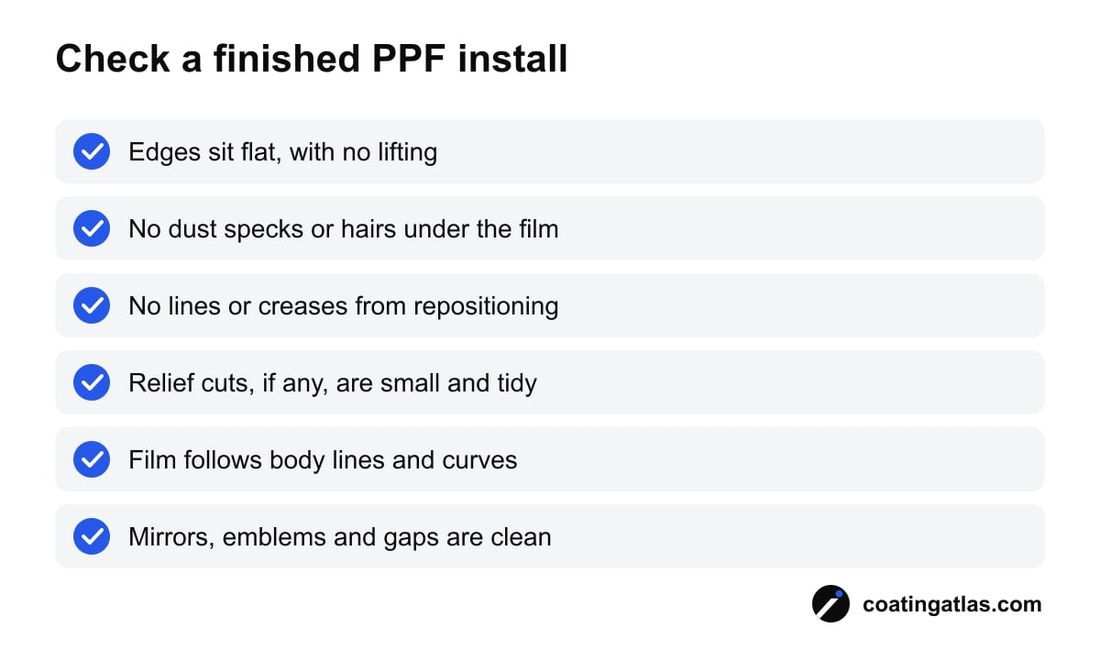
Point out anything that looks wrong to the installer in writing before the wait period ends, so it is on record. Bubbles are covered below.
How long does the film take to settle?
Film needs time to cure, which means the adhesive finishes bonding. Avery Dennison's FAQ recommends waiting 24 to 72 hours in the right conditions before it fully cures. XPEL says bubbles from application typically go away within a few days to a few weeks as the film settles and the adhesive cures.
Wash waits vary by maker:
- XPEL and Avery Dennison: 48 hours for most films.
- XPEL COLOR PPF: 72 hours.
- LLumar: 72 hours.
- SunTek: three days.
What worries owners about installation?
- "I see bubbles." XPEL says most go away within days to weeks. If one stays, ask the installer. Don't press on it.
- "The edges are lifting." LLumar says pressure washing and automatic washes can cause lifting. Avoid both while the film settles, and tell the installer.
- "Can I wax it?" STEK says you should not wax its PPF. SunTek says to wax gloss finishes once or twice a year. Ask the maker about your film.
- "How do they trim the film?" Ask the shop how it cuts, and see questions to ask a PPF installer.
- "Can I put PPF on a leased car?" Check your lease rules and ask the leasing company. How to remove PPF explains what removal involves.
Which choice fits you?
Say you have a new truck with a warranty and you want a 10-year film. A professional shop that is authorized for the brand keeps the paperwork simple.
Say you are handy and want to cover only a small area, like door cups, with a kit. Read the kit maker's warranty first. Expect a learning curve, and plan for a redo.
For the film itself, see what PPF is. To decide which panels to cover, read which parts of a car should get PPF.
What does a professional install cost?
Prices depend on the film, the panels and the shop. These are prices shops publish, not quotes.
| Package | Typical price | Shops |
|---|---|---|
| Partial front | $900–$1,300 | 611 |
| Full front | $1,800–$2,200 | 754 |
| Track pack | $2,400–$3,000 | 322 |
| Full body | $5,000–$6,500 | 631 |
See PPF cost for more. Find a PPF installer near you, or start with a state like Florida. How to choose a PPF installer helps you compare shops.
Questions
Is PPF hard to install?
It takes skill. Avery Dennison's bulletin says curved areas need film pulled and stretched to fit, deep recesses may need a relief cut, and repositioning is only possible early in the process. XPEL says professional installation is highly recommended for the best results.
Can you apply PPF without water?
Avery Dennison's bulletin describes a wet install, with a soap solution and a water and alcohol mix. SunTek says its film uses a wet installation. Ask the maker for the method for your film.
How do you make PPF slip solution?
Avery Dennison recommends 1 liter of water mixed with 2 mL of baby soap for its film. Other makers may give other mixes, so check the instructions for the film you use.
What is pre-cut PPF?
Pre-cut film is cut from a pattern for the car's model instead of by hand. XPEL says its DAP software has over 80,000 precision-cut patterns for vehicles of every make and model. Bulk film comes on a roll and is cut by hand and trimmed on the car.
How long after install can you wash the car?
It depends on the maker. XPEL and Avery Dennison say wait 48 hours for most films, XPEL says 72 hours for COLOR PPF, and LLumar and SunTek say to wait about three days.
Sources
- Avery Dennison application bulletin IB4.30
- Avery Dennison PPF FAQ
- Avery Dennison: the science behind paint protection films
- XPEL FAQs
- XPEL warranty information
- XPEL product care
- SunTek PPF FAQ
- LLumar PPF FAQ
- XPEL DAP
- STEK USA: DYNOshield
Checked 5 Nov 2026. Manufacturers change their terms, so confirm with the current document.
A US directory of PPF and ceramic coating installers. Our guides draw on manufacturers' published information and the prices shops publish on their own websites. Brands and shops don't pay for coverage. Read our editorial policy.