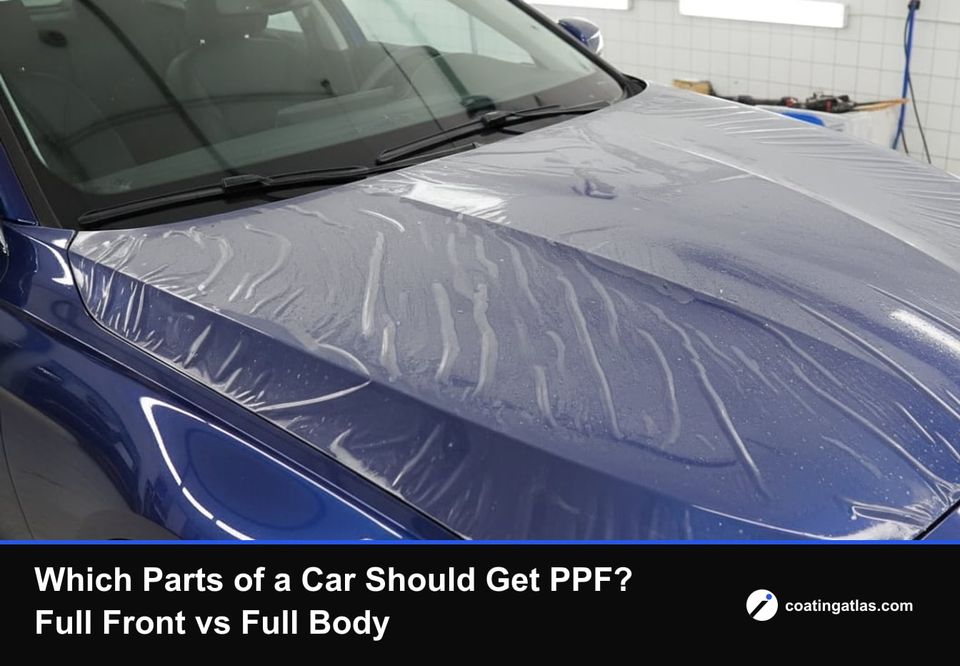
The parts of a car that should get PPF first are the front bumper, hood, fenders and side mirrors, because makers call them high-impact areas. XPEL, LLumar and Avery Dennison each name front-end panels such as the bumper and hood, and each says you can cover more, up to the whole car. Package names like "full front" are not standard, so get the panel list in writing.
Which parts of a car should get PPF?
Start with the panels that face forward, because they meet the road first. Avery Dennison says to protect "at least the high-impact areas such as the front bumper, hood, fenders, and mirrors." LLumar names the front bumper, hood and rocker panels. It says some owners protect all painted surfaces instead.
Those are makers describing their own film. Use the list as a start, then adjust for your own driving.
What five areas does XPEL say to protect?
XPEL's own list gives a reason for each area:
- Front bumper. XPEL says it takes abuse from road debris, rocks, insects and minor impacts, which can cause chips and scuffs.
- Hood and fenders. XPEL says gravel, sand, salt and debris kicked up by traffic can chip and scratch these panels.
- Side view mirrors. XPEL says they are often overlooked but vulnerable to minor impacts and scratches, like parking lot bumps and branches.
- Behind the rear wheels. XPEL says this paint collects mud, tar and rubber that are hard to clean.
- Rocker panels. These are the panels under the doors. XPEL says drive-thru automated car washes commonly neglect them, and that shoes scuff them when you get in and out.
Ceramic Pro lists a similar front group: the front end, fender, bumper, hood, grille and side-view mirrors.
Avery Dennison's install bulletin goes further. It says its film can go on "car fronts, wheel arches, rocker panels, door edges, pillars" and similar areas.
How far does the film go?
This diagram shows how the options stack up, from least to most paint covered.
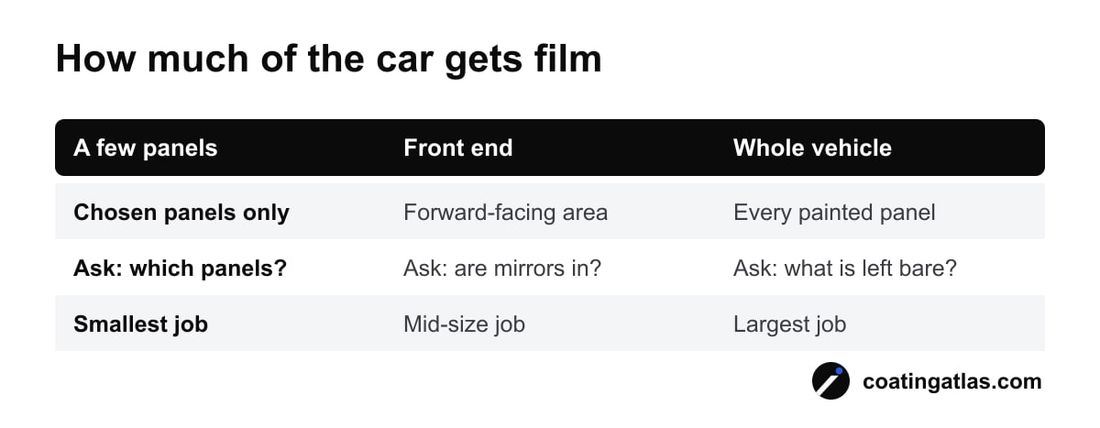
What do partial front, full front and full body mean?
These names say roughly how much of the car gets film, but they are not a standard. The same name can mean different panels at different shops. That is why the panel list on your quote matters more than the package name. What a PPF quote should include shows what to get in writing.
You will see three common levels:
| Level | The idea | What to confirm |
|---|---|---|
| A few panels | Film on chosen panels only, like the bumper and mirrors | Which panels, and where the film ends |
| Front-end package | Film on the forward-facing area | The exact panels, and whether mirrors and headlights are in |
| Whole vehicle | Film on the entire car, which XPEL and Avery Dennison say is possible | Which edges and tight spots are left bare |
Does full body PPF cover every inch of paint?
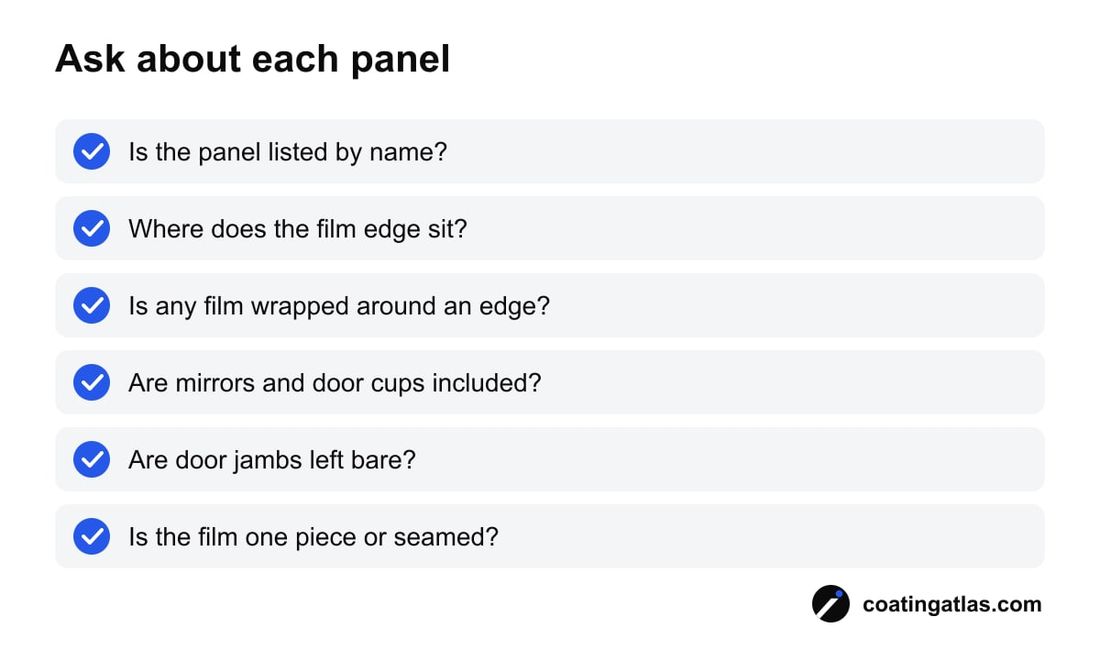
Not always. Film is cut to fit each panel, so the shape of the car decides what it can reach. Tight corners, edges and door jambs (the painted strip inside the door opening) are worth asking about.
A partial front has its own trade-off. XPEL says the edge of the film may be slightly noticeable, depending on your paint color and finish. If you cover only part of a hood, ask where the edge will sit.
Can you put PPF on door edges, the roof, headlights or the windshield?
Some of these are covered by paint film. Some are separate products.
- Door edges and door cups. Avery Dennison's bulletin lists door edges among the areas its film can cover. Door cups are the dished area under each handle, where fingernails leave scratches. Ask if they are in the quote.
- Roof. XPEL says you can cover your whole vehicle with its film. A roof is part of a whole-vehicle job, so ask whether the shop sells it on its own.
- Wheel arches and pillars. Avery Dennison's bulletin names wheel arches and pillars too.
- Headlights. XPEL sells headlight protection film as its own product. It describes it as protection from scratches, chips and UV damage. Whether you can put PPF on headlights has the details.
- Windshield. XPEL's windshield film is a separate product from its paint film. Its warranty is 1 year/12,000 miles, and XPEL says rock chips are not covered because the film is designed to act as a sacrificial layer. Whether you can PPF a windshield explains more.
- Wheels and rims. Ask the shop what it will and won't film.
Does PPF stop door dings?
PPF can soften a light bump, but it does not make a door dent-proof. XPEL says its film "can help reduce the impact of minor door dings and scratches." It also says the film "may not completely prevent damage from more severe impacts."
A dent is damage to the metal. A parking lot swing of a car door can still dent a panel with film on it. If dings are your main worry, ask the shop whether door edge guards or cup film fits the job.
What happens at edges and tight spots?
Film is cut and stretched to fit each panel, and the edges are where a job is judged. Avery Dennison's bulletin says curved areas need the film pulled firmly to fit, and that deep, corrugated shapes may need a relief cut (a small slit that lets the film lie flat). It says the cut does not hurt how the film works or lasts.
The same bulletin says installers should trim with new, very sharp knives, because dull ones leave blurred edges. They then re-squeegee edges and spray them with a water and alcohol mix to help them stick. You can't judge this from a quote, so look at a finished car in person.
Does the finish matter when you pick panels?
Yes, if you want a look change. XPEL says its STEALTH film has a satin finish that turns glossy paint into a matte look. A matte film on a few panels would look odd next to gloss paint, so a satin finish usually means covering the whole car. That is general reasoning, not a maker rule. Ask the shop to show a sample on a panel.
What are owners usually worried about?
- "Will I see the film?" XPEL says it may be slightly noticeable at the edge of a partial front. Ask the shop to show you an edge on a finished car in a similar color.
- "What about the wheels, roof and trunk?" Ask the shop if each one is in the quote or sold as an add-on.
- "How long until I get the car back?" Install time depends on the car and the number of panels. Ask for a pickup date in writing, and remember that makers set a wait of 48 to 72 hours before the first wash.
- "What if my car was repainted?" Avery Dennison says its film is intended for fully cured factory paint. Tell the shop about any repaint before you choose coverage.
How do you choose a coverage level?
Match coverage to how you drive and how long you will keep the car. Here are two examples.
Say you drive 60 miles of highway each way to work in a pickup. The bumper, hood, fenders and mirrors face the road first, so a front-end package may be what you need. You could skip the rear panels.
Say you lease a new car for three years and park it on city streets. Mirrors, door edges and rocker panels may matter more than the hood. Ask the shop for a few panels rather than a full front.
Ceramic Pro argues that owners who plan to keep a car for a long time should think about full-vehicle coverage. That is a maker's view, not a rule. Compare quotes on the same panels, not on package names.
What does PPF cost by coverage?
Cost depends on the film, the panels and the shop. Each extra panel adds film and labor, and a bumper with many curves takes more fitting time than a flat door. Two jobs with the same panel count can still differ. Prices below are what shops publish, not quotes.
| Package | Typical price | Shops |
|---|---|---|
| Partial front | $900–$1,300 | 611 |
| Full front | $1,800–$2,200 | 754 |
| Track pack | $2,400–$3,000 | 322 |
| Full body | $5,000–$6,500 | 631 |
The PPF cost guide explains what drives the difference. When you are ready, find a PPF installer near you, or browse a state such as Texas. Read how to choose a PPF installer before you compare shops. For the basics, see what PPF is, and for whether the spend suits you, is PPF worth it.
Questions
Can you put PPF on just one panel?
Yes. SunTek says you can fully wrap your vehicle or cover several panels, and LLumar says some owners protect only the areas that take the most punishment.
Does PPF cover the whole car?
It can. XPEL says you can cover your whole vehicle with its film, and Avery Dennison says its film can also be applied to the full vehicle.
Will the edge of the film show on a partial front?
It may. XPEL says that with a partial front end the edge may be slightly noticeable, depending on the color and finish of the vehicle.
Does PPF stop door dings?
Only light ones. XPEL says its film can help reduce the impact of minor door dings and scratches, and may not completely prevent damage from more severe impacts.
Can you PPF a windshield?
XPEL sells windshield film as a separate product from its paint film, with a 1-year/12,000 mile warranty. XPEL says rock chips are not covered, because the film is designed to act as a sacrificial layer.
Sources
- XPEL: top 5 areas on a car to protect
- XPEL FAQs
- LLumar PPF FAQ
- Avery Dennison PPF FAQ
- Avery Dennison application bulletin IB4.30
- SunTek PPF FAQ
- Ceramic Pro: pros and cons of PPF on new cars
Checked 5 Nov 2026. Manufacturers change their terms, so confirm with the current document.
A US directory of PPF and ceramic coating installers. Our guides draw on manufacturers' published information and the prices shops publish on their own websites. Brands and shops don't pay for coverage. Read our editorial policy.